
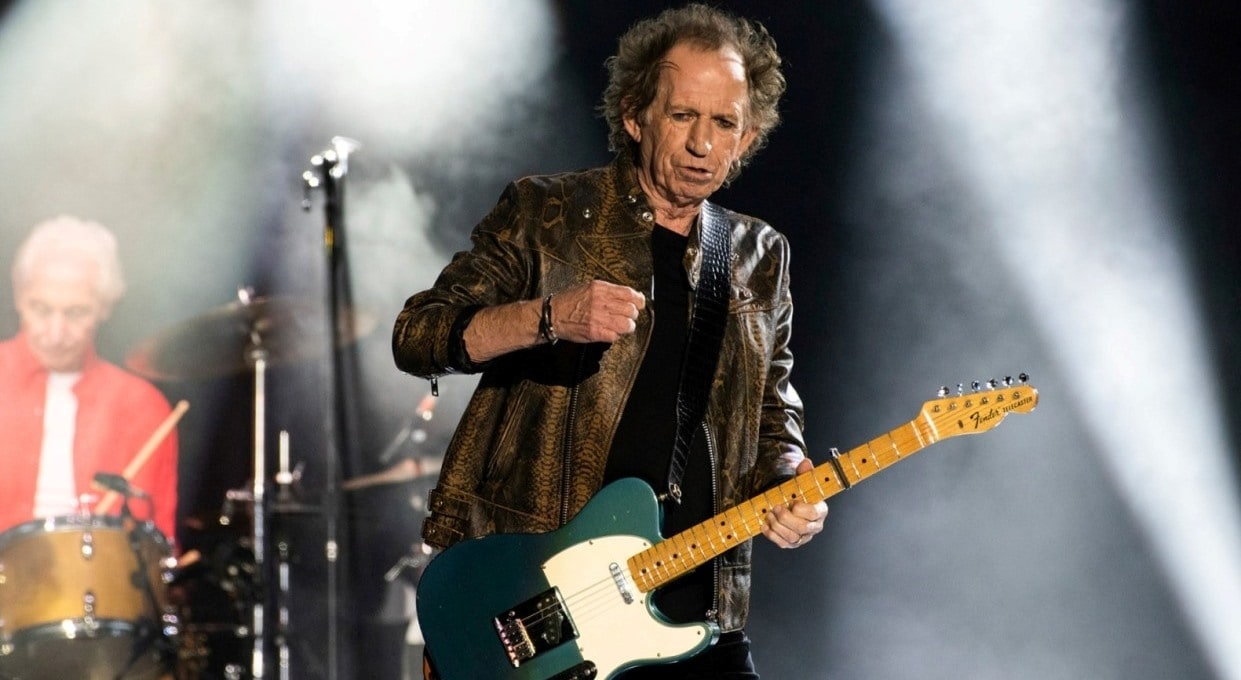
Almost 19 years after the Rolling Stones put out their last studio album, A Bigger Bang (2005), the UK rock and roll phenomenon is back with a handful of amazing songs that can make you dance, scream, and shout.
The album is full of Rolling Stones magic with all the hooks, nuances, and raunchy, rocking playing from the most famous rhythm guitar player in history: Keith Richards.
The band is back big time, but is the riffmaster still at the peak of his game?
Table of Contents
The Drummer’s Gone, The Feel Remains

Recently, Keith Richards turned 80, the age that his dear friend and legendary co-equipper Charlie Watts was when he passed away. This is the first Rolling Stones album without him. It’s curious because the tandem Watts-Richards worked like a well-oiled machine and the drummer was playing to the right-hand beat of Richards.
Although Watts’ drumming is featured in “Mess it Up” and “Live by the Sword”, the drumming duties were in the hands of Steve Jordan, who has worked with countless number-one artists including Richards’ X-Pensive Winos.
With Jordan, the band gained some muscle and modern-day drumming power, the moment you hear Watts’ tracks, though, you know immediately that the snare is his signature sound.
This is my first point. I think the inclusion of Jordan’s magic touch helps Keith get even more out of that right hand. The riff to the opening single “Angry” is a great example of that.
5 Strings and a Wingman
Recently, in an interview, Richards said “That’s the sound of a Stones record: a five-string with a six-string on top, and Ronnie.” I couldn’t agree more with that statement.
What we all know as the Richards tuning or open G (D-G-D-G-B-d) minus the sixth string works great to create a familiar sound the minute the savage riff for the opening single “Angry” takes off. It’s the same old Rolling Stone recipe with guitars making room for vocals and playing hide and seek with hooks and melodies.
Perhaps, one thing that I can say about this album is that not only Keith is playing some of his best material, but Ronnie Wood is at his all-time best as well. Songs like “Dreamy Skies” wouldn’t be a fraction of what they are without Ronnie’s Dobro playing.
Still, the star of the album is the band and all the complexity of their two-guitar-a-bass-and-a-piano approach. The Rolling Stones understood early on that there’s nothing as important as the song itself and thus, choruses are huge, happy, and lush, while guitars remain rocking between tasty minimalism and arena-rock grandiloquence.
This is my second point. Keith does his thing to make the biggest band in the world even bigger, and the band echoes this making great songs.
Some Relevant Axes
The Riffmaster is still at the peak of his game, but what is he playing?
The moment you hear the riff for the opening song you can immediately hear the blend of guitar sounds and recognize a maple fingerboard somewhere along with some low-end from either a hollow-body guitar or a big-bodied mahogany one.
Yes, the secret ingredient for the Rolling Stones recipe has always been teamwork. Yet, some of the guitars used for the making of the record need to be spoken about.
To begin with, let me tell you about a very special acoustic guitar dating back to the 1920s. Surprisingly, though, this 100-year-old guitar doesn’t belong to the 80-year-old Keith Richards but to Andy Watt, the 32-year-old star producer (more on him in a bit).
He presented the band with a 1920s L-4, a guitar that’s close to the L-1 used by Robert Johnson to basically set the foundations for all we know as modern rock guitar. That was the inspiration for Keith and Mick to play Muddy Waters’ “Rolling Stone Blues”, the song that gave the band its name.
Ron, on his side, played his ‘50s Stratocasters but also brought to the scene the very iconic Zemaitis from The Faces era.
Other than these guitars, the record features 335s, Telecasters, Les Paul Juniors, and more vintage pearls from Keith’s and Ron’s collections.
Iconic Amps? We Need More!

Keith Richards has been recording with a trio of amazing vintage Fender amps and a Watkins Joker made in the early ‘60s.
Although these were present during the studio sessions, the band’s leap came again from Andy Watt’s side because the producer brought in 5 Dumble-modified vintage Fender amps that served as the inspiration for the Rolling Stones’ new, muscular, rocking, and fun sound we can hear in Hackney Diamonds.
Beware, The Tongue Keeps on Licking!
The new album by the Rolling Stones is right up there with some of the best in their career. In my opinion, the magic of Keith’s right hand is more alive than ever and has been enhanced by the muscular power of their new drummer, the legendary Steve Jones.
Yet, there’s one more thing that needs addressing because Old Uncle Keef isn’t just back in the game big time, he also got together with a producer who kept on pushing and defying him to get his best version yet. I know it sounds weird to say this about a man with a 60+-year career, but the proof is right in sight.
The band is back, the magic is intact, the man is at the peak of his game, and the tongue will just keep on licking for years to come. After all, it’s only rock and roll, but we love it!
Happy (5-string) playing!
