

I have very vivid memories of the days I first became interested in vinyl records. I was in college, visiting a friend in his dorm room. He was playing Halo, but the television was muted. Instead of loud gunshots and freakish alien sounds, he was blasting Glen Miller’s big band in all its saxophone-led splendor.
Needless to say, it was a strange combination.
Despite the absurdity, I was still fascinated. I dreamed of building my own collection. I was frugal with my money, relying on my parents to buy me a turntable as a graduation gift. I spent my first post-grad summer perusing record shops in downtown Dayton, Ohio.
I quickly realized something: vinyl records were expensive, even brand-new reprints of old classics! I ended up spending $200 on records I still enjoy. But I left with far less than I’d initially expected.
Why is this? Why is a decidedly old-fashioned media platform so expensive even today? The subject is full of many factors, covering economics, production, and business tactics.
I promise it’s still interesting though — let’s get started!
Vinyl’s Temperamental History

Vinyl records were invented in 1887 – but you don’t really have to care about that. As far as we’re concerned, they didn’t reach the public until the 1930s, becoming most popular in the 50s and 60s.
Before that, folks had to rely on the radio to hear their favorite tunes. With the advent of records, they could own their favorite songs for the first time (something we certainly take for granted now, if you even still buy songs).
As the only medium available, it was understandably the de-facto way to collect music. It wasn’t “special,” it’s just what you bought and listened to.
All that changed in the 80s, however. With the introduction of CDs and cassettes, the public realized they could buy music for cheaper. More importantly, they could carry it around with them. Records were portable, of course, but CDs and cassettes were far more convenient.
By the mid-90s, vinyl records were almost obsolete. Most people didn’t think they were that special.
With the introduction of digital media and iPods in 2001, you would think that vinyl would disappear completely. However, surprisingly it had a huge resurgence in 2006.
Why? I’m not sure. However, I suspect it was a reaction to increasing digitalization and a nostalgia for analog days. Whatever the reason, this vinyl resurgence has continued to grow to the present day.
And there you have it: vinyl’s history in a nutshell. While it’s not immediately apparent now, this knowledge will help us understand the rest of the article.
Physical Media and Factories: The High Production Value of Vinyl
Regardless of inflation, momentary economics, and cultural shifts, one thing has remained constant about records: a significant portion of their cost comes from how they’re made. Prices may have changed through the years, but production value has always been high.
The first step in record production is the mastering process. Every medium (MP3, cassette, etc.) works best with a unique type of sound design. It takes a highly skilled mixing engineer to optimize a track for vinyl-pressed records. As a result, the engineer gets a cut of the shares alongside the artists, producers, and record companies.
Next, the factory needs an official “master” copy of the record. Using highly specialized gear, they etch the soundwave grooves into a metal disc with a laser. This disc is referred to as the “master disc,” and every other disc is derived from it.
Next, a mold is made of the master disc. By encasing it temporarily in nickel, they create the ‘stamps’ needed to repress the grooves into other discs. These stamps are referred to as “stamper discs.”
At this point, the factory personnel conducts a quality check of the stamper discs to ensure everything is up to standards. (And what do they do with defective ones? … they give them to teachers like me so I can decorate my classroom! :P)
Once all that is done, they can begin the actual process of creating records. Each record is created by squeezing “biscuits” of vinyl in between the stamper discs.
But wait, we’re not done yet!! After several discs are made, they have to be vetted by a bunch of bigwigs: the artists, producers, mastering engineers, and record labels. This, like everything else in this process, costs money.
Once everyone’s happy (or at least appeased!), they can begin wrapping and distributing the records.
Whew! I know that’s a lot of information. But hopefully, it helps you appreciate the work that goes into creating physical discs. Furthermore, it helps explain why they cost more money than immaterial MP3s.
On top of that, more costs are required to transport the discs from the factories to the stores.
Record Economics: How Technology and Trends Affect Vinyl Prices

We’ve established that the intense production process automatically makes records expensive. But even then, if production was the only factor, some records would sell for as little as $5. Tack on transportation, and it’d probably be $10.
But in 2023, how much do vinyl records cost? On average, they’re around $20 to $30. What gives?
If you know anything about economics, even just a little, you’ve probably heard the term “supply and demand.” This refers to the dynamic between the number of products and the number of consumers wanting them.
Usually, if there is high demand and low supply, high prices can be justified. If there is low demand and high supply, low prices are required to make a profit. However, it’s best when supply and demand meet halfway to make both parties happy.
This is where culture and other factors impact the numbers. Interestingly, record prices have fallen on all points of the spectrum through the years.
As the sole medium for owning music, they were highly accessible during the 50s and 60s. However, record labels began taking advantage of their popularity in the 70s.
While they were already priced perfectly, companies started gouging customers with higher prices. They knew customers would buy anyway, so why not take advantage of it? While many might think that records are overly expensive today, they were actually more expensive in 1978!
Given the rise of CDs and cassettes, it makes sense that vinyl prices plummeted in the 90s. There was low demand, so companies had to make prices low enough to guarantee profit.
The present time, and really any time after 2006, brings up a new scenario entirely. A renewed interest in records created a higher demand for vinyl products. Unfortunately, there were very few factories and laborers making them anymore.
Because of the low supply, prices were justifiably high. Consumers had to pay for production, transportation, and the limited supply of both. This was based on pure numbers, unlike the opportunist capitalists of the 70s.
Interestingly, demand grew even higher and faster, during the COVID-19 pandemic. When everyone’s stuck at home, they find new hobbies and interests to occupy their time.
With its ever-increasing demand and growing production industry, it makes sense why vinyl records are relatively expensive today.
Still though.
I’m not complaining, but currently there sure do seem to be some ridiculous prices out there. No, scratch that – make that a looooooot!
As great as new and old artists both are, it’s hard to justify paying $40+ for brand-new prints. Yet that’s normal these days.
Are there some cases where records are just plain too expensive?
I think so. Here are some reasons.
When Records Get Too Expensive …
As mentioned, a rise in vinyl record prices has its merit. However, as trends come and the rich get richer, inevitably another factor enters the picture: greed.
This isn’t an opinion article, nor am I just trash-talking to trash-talk. Unfortunately, though, capitalism does have an ugly side.
At its most obvious, big businesses hike up prices for trends simply because they can. When the vinyl market is growing by the thousands, and many don’t think about what they’re spending, music companies will take advantage of that.
You will find tons of record companies that jack up prices for the sake of “novelty,” and record shops that jack them up because they’re “hip” and “exclusive.” They want you to feel special, and that feeling comes from a niche, expensive product.
Don’t fall for it though. Here’s my opinion: as great as the Beatle’s Sergeant Pepper’s and Fleetwood Mac’s Rumors are, they’ve been around for decades. Everyone knows and loves them (for good reason!), and there are thousands of MP3s, CDs, cassettes, records, and who knows what else out there.
Given that, why sell them for $45 as a newly printed, brand-new vinyl print? These bands deserve respect, but it doesn’t have to boil down to opportunist prices. Instead, we should be spending $45+ on the original prints from the 60s and 70s – the real, original museum pieces.
Sometimes, companies will chalk up high prices to “superior” production designs. For example, records made in the 20th century weighed around 130 grams. After vinyl’s resurgence, many factories are making them at 180 grams.
These factories argue that the added weight makes the records durable and last longer. I don’t know if they do, but I’m not trying to disagree. I don’t see why not.
But I also know that my original records from Harry Belafonte and the Rolling Stones sound just fine – and they’re at least 50 years old! What I am saying is that maybe we don’t need all the newest bells and whistles.
The Future of Vinyl Record Prices
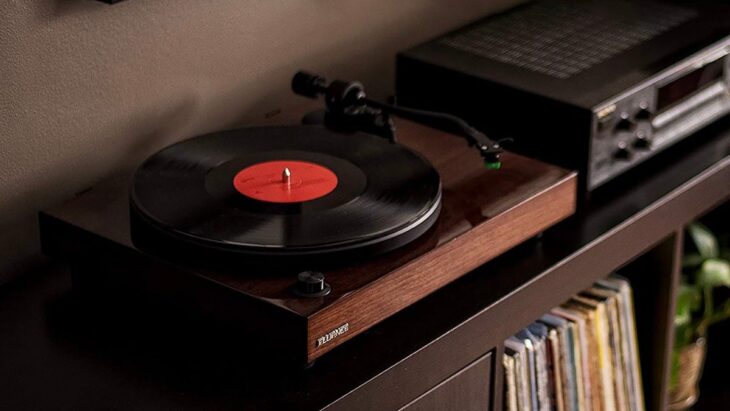
Despite their rise in prices, I firmly believe that records are a valuable and exciting way to experience music. As I explored in another article, they allow you to step back in time, slow down, and explore music in a completely new way. Plus, they offer a fantastic way to highlight your choices in music by displaying them prominently at your home.
But with some of the crazy prices out there, it begs the question: will their prices ever go down? How much will vinyl records cost in the next decade?
Economically speaking, there comes a point where excessively high prices will kill any market. With record prices approaching the highest they’ve ever been in history, there has to be a point in the near future where rising prices aren’t feasible.
It’s hard to say where that price is, and how much it will decrease after that. What I can say, however, is that the vinyl market is here to stay for a long time.
It may always remain niche, and will always have to be more expensive than digital music. However, as a way of distancing from digitalization, exploring music, and experiencing nostalgia, nothing is better.
Here’s what I suggest: be picky about who you buy from and how much you spend. Explore new artists, sites, and stores. Don’t just buy and listen – do your best to influence the market.
There are good record prices out there if you’re willing to find them, and there’s hope for lower prices in the future! In the meantime, enjoy the search, and always, ALWAYS, have fun!
